6 Starbridge alternatives for government and education GTM in 2026
Compare GovSpend, ZoomInfo, GovWin, Burbio, Agile, and BidNet Direct with Starbridge on buying signals, contact data, spend, RFPs, and contract vehicles.

Choosing a GTM platform for local government, K–12, and higher education comes down to how early your reps find a deal and how fast they can close it.
Most Starbridge alternatives cover one slice of that motion, such as historical spend research, federal capture, or bid notifications.
| Platform | Identifying opportunities before RFPs | Contact and account data quality | Visibility into agency spend | Finding and responding to RFPs | Contract vehicle access |
|---|---|---|---|---|---|
| Starbridge | Buying signals from board meetings, budgets, and contract expirations | Verified contacts from continuous crawls of official government and school sites | Full competitor contracts and purchase order data, cross-referenced with buying signals | Scored RFP feed with AI proposal drafting | Available as part of the platform, with compliance, paperwork, and renewals handled by Starbridge |
| GovSpend | Meeting transcript search and a newer AI Opportunities module | Contact records alongside procurement data, with reviewer-reported freshness gaps | Deep historical purchase order and vendor spend records | Bid alerts on matching solicitations | Cooperative contract data for research, but no contract vehicle access as of October 2026 |
| ZoomInfo | Commercial intent data rather than board, budget, or grant activity | Broad B2B coverage partly drawn from LinkedIn and commercial sources | Commercial firmographic and technographic focus | Traditionally used for commercial sales motions rather than bid workflows | Contract vehicle access is not part of the offering as of October 2026 |
| GovWin | Analyst-backed federal opportunity intelligence and recompete tracking | Analyst research and agency org charts, deepest at the federal level | Federal award tracking and pricing research | Large bid database with folder management | GSA Schedule data for research, but no contract vehicle access as of October 2026 |
| Burbio | K–12 board meetings, calendars, and plans | K–12 focus with recent research hub additions | Vendor payment and contract data for K–12 districts | Daily K–12 RFP tracking, with proposal drafting not stated | Contract vehicle access is not part of the offering as of October 2026 |
| Agile Education Marketing | EdIntel tracks K–12 board minutes, budgets, funding, and leadership changes | Licensed educator lists from pre-K through higher education, periodically refreshed | District funding, spending, and adoption data rather than a general purchase order database | Campaign lists rather than bid discovery | Contract vehicle access is not part of the offering as of October 2026 |
| BidNet Direct | Surfaces solicitations after publication | Bid matching by category and location rather than contact enrichment | Award notices rather than historical spend analysis | Matched bid notifications with real-time addenda | Contract vehicle access is not part of the offering as of October 2026 |
1. GovSpend

GovSpend is a procurement intelligence platform traditionally used for historical purchase order research. Teams use it to see what agencies bought and what they paid each vendor, which helps when sizing a market or pricing against an incumbent.
What GovSpend does well
GovSpend’s core strength is deep historical purchase order and vendor spend data. Reps can identify incumbents and benchmark pricing by account. Contract records also help teams spot recompete windows before a renewal.
Meeting transcript search adds another angle. Teams can track what boards and councils discuss about budgets and upcoming purchases. Bid alerts then flag new solicitations that match saved criteria, which rounds out a multi-angle view of agency activity.
GovSpend has also layered newer AI research tools on top of its procurement data. The Opportunities module surfaces relevant activity each day. AI Search and AI Notebook help reps query that data and organize saved searches in one workspace.
Where GovSpend falls short
While data is GovSpend’s strong suit, some users find it may not always be accurate. “Sometimes data is missing or not entered correctly or is out of date,” wrote one G2 reviewer in February 2026. In a market where outreach timing hinges on contract dates, stale records may send reps after the wrong window.
Another G2 reviewer said monitoring widely ranging keywords in their industry “can result in false positive reports of potential response opportunities.” Someone may then have to filter those results by hand before a rep can act.
Also, proposal drafting in GovSpend runs through a third-party provider, and contract vehicle access is not part of the offering as of October 2026.
How Starbridge compares
GovSpend and Starbridge both cover purchase orders, but they go to different depths. GovSpend’s Spending & POs and Co-Ops & Contracts modules show who bought what, who holds active contracts, and when those contracts expire. Starbridge’s Public Spend Intelligence enriches the full competitor contract, including pricing, opt-out clauses, and the vendor’s original proposal, sourced through automated public records requests. Out of the box, Starbridge has purchase order data for 77% of local government, K–12, and higher education institutions.
That depth changes the first call. Reps walk into discovery knowing what the prospect pays the incumbent, how the contract can be exited, and when it ends. A contract expiration becomes a displacement play that starts while the incumbent is still in place.
The two platforms also differ on what happens after a signal appears. GovSpend’s Opportunities module ranks signals by relevance to your company profile and includes contacts, AI outreach drafting, and CRM integrations. Starbridge pairs each signal with a verified decision-maker, a reason for outreach, and AI-generated copy, plus multi-step email outbound sent directly from your own inboxes through Starbridge Sequences. Proposals follow the same pattern, since GovSpend partners with Iris for drafting while Starbridge’s AI proposal writer is built in.
At Frontline Education, account research that used to take two hours now takes five minutes — a 90% reduction in research time. GovSpend still fits teams focused on historical spend analysis and pricing benchmarks. For the full breakdown, see Starbridge vs. GovSpend.
2. ZoomInfo

ZoomInfo is a horizontal B2B data platform traditionally used by teams selling to commercial buyers. The open question is how well a commercial database reaches school and city buyers.
What ZoomInfo does well
ZoomInfo offers broad commercial contact and company coverage. Teams with mixed commercial and government territories can prospect both from one database. For a rep covering a regional bank one day and a software company the next, that range saves a tool switch.
The enrichment and sales engagement workflows are mature and familiar to most SDR teams. Reps can build lists and enrich records with workflows many have used in past roles. For a manager onboarding new reps, that familiarity is a practical plus.
One vendor across segments also simplifies procurement and admin. Diversified revenue teams manage a single contract and renewal instead of several. For RevOps, fewer vendors mean fewer integrations to maintain.
Where ZoomInfo falls short
For government and education sellers, the test is whether ZoomInfo has current, usable contacts for the specific districts, agencies, and roles in their territory. A large commercial database is less useful if a rep still has to verify who holds the role and which email address reaches them.
Contact freshness matters as much as coverage. One G2 reviewer said the data “isn’t updated as often as we expected, so we still rely on other tools to fill in the gaps.”
One data vendor, Prospeo, reports that most teams see 15% to 25% bounce rates on unfiltered ZoomInfo exports. In a finite market where sender reputation matters, that range adds up fast. Contract vehicle access is not part of the offering as of October 2026.
How Starbridge compares
ZoomInfo’s company and contact database is built for B2B breadth, and its intent data tracks article reads, downloads, and topic searches across publisher sites. Superintendents and city procurement officers leave a different trail, in board votes, budget approvals, and grant awards.
Starbridge builds both its contacts and its signals from that public trail. Contacts & Company Data comes from continuous crawls of official government and school sites using proprietary web-agent technology, with waterfall enrichment and ongoing bounce-checking. In a 14,000-email test, that produced 98% email accuracy and a 2% bounce rate, against the 15% to 25% reported above for unfiltered ZoomInfo exports. Starbridge’s buying signals come from board minutes, budgets, grants, and contract expirations, each paired with a verified contact.
ZoomInfo also stops before the procurement side of the deal. RFP discovery, proposal drafting, and contract vehicle access aren’t stated ZoomInfo capabilities as of October 2026, and Starbridge covers all three.
TAM to Target reports Starbridge contact data is 3 to 4x more valid than other vendors it has used. ZoomInfo still suits teams with large commercial books and only a few government accounts. For the full comparison, see Starbridge vs. ZoomInfo.
3. GovWin

GovWin, a Deltek product, is a market intelligence platform traditionally used for federal capture and bid-centric pursuits. Capture teams use it to track federal programs well before award, and contractors who depend on recompetes often treat it as a core research tool.
What GovWin does well
GovWin’s strongest asset is analyst-backed federal opportunity intelligence. Analysts track programs and recompetes, giving capture teams an early read on federal pursuits. That research saves capture managers significant legwork.
The platform also offers a large bid and contract database. Federal pricing and competitor research help teams price proposals and size up rivals. Capture managers can see who won similar work and plan positioning from there.
Opportunity tracking helps capture teams manage high solicitation volume. Teams can follow leads across every market they serve and get alerted when a program changes status or a document is added.
Where GovWin falls short
“Searching outside of my saved searches is challenging,” wrote one G2 reviewer in June 2025. The same reviewer added, “The filters are not user-friendly… Lately postings have been missing attachments or have wrong dates.” For reps who need to look past saved searches, that friction slows discovery.
GovWin covers state, local, and education markets, but some users may want deeper SLED insight and easier search. In March 2026, one G2 reviewer asked for “more SLED insights,” while another said, “Refining searches can be difficult especially at the state and local level.” For teams focused on cities and school districts, those limitations may add research time before reps find an opportunity worth pursuing.
How Starbridge compares
GovWin gets sellers in early through people. Its analysts monitor thousands of sources and talk directly to government, and its deepest coverage is federal, where analysts track programs years before public release. Starbridge gets there through AI, monitoring 320k+ local government, K–12, and higher education entities around the clock. That includes board meeting recordings, which Starbridge transcribes and searches by meaning rather than keyword.
The bigger gap is what happens after a signal appears. Starbridge’s Buying Signal Monitor pairs every signal with a verified contact, a reason for outreach, and AI-generated copy, then scores accounts so reps know who to call first. Those records sync both ways with Salesforce and HubSpot. GovWin’s documented CRM integrations include Salesforce, Vantagepoint, and Costpoint.
Procurement differs too. Starbridge includes access to NASPO ValuePoint, OMNIA Partners, Sourcewell, TIPS, and GSA, along with an AI proposal writer for the bids worth pursuing.
GovWell booked five meetings from Starbridge buying signals in its first week and now sources 15% of its qualified pipeline from Starbridge. GovWin remains the stronger pick for federal capture teams that rely on analyst-backed forecasts. For the full breakdown, see Starbridge vs. GovWin.
4. Burbio

Burbio is a K–12 intelligence tool traditionally used to track school board meetings, calendars, and plans. Edtech teams use it to follow district discussions and the timing of key decisions, which keeps the feed relevant for school-only sellers. The trade-off shows up once a team sells beyond K–12 or adds more reps.
What Burbio does well
Burbio offers focused K–12 board meeting and calendar monitoring. Teams can follow district agendas and planning documents without visiting hundreds of district sites one by one. That focus suits sellers whose entire TAM is school districts.
Burbio has also broadened its K–12 data. Its platform now includes buying signals from board meetings and district documents, vendor payments and contracts, district contacts, RFP tracking, and a Construction Tracker for school building projects.
Where Burbio falls short
Burbio’s coverage is K–12 only. Local government and higher education coverage is not stated as of October 2026. Teams selling to both schools and cities would need a second source. The same applies to edtech companies that also sell to universities.
Account scoring, CRM routing, and outreach automation are not stated capabilities as of October 2026. This means someone still has to rank the accounts and write the first email.
On a team of several reps, that manual work grows with each new territory. A single researcher can absorb it, but a full rep team feels the drag. Contract vehicle access is not part of the offering as of October 2026.
How Starbridge compares
Burbio and Starbridge both treat board discussions as buying signals, and Burbio’s Signals do that well for school districts. The differences are coverage and what happens after a signal appears.
Burbio covers public schools only, so teams that also sell to cities, counties, or universities need a second tool. Starbridge covers local government, K–12, and higher education in one platform. Much of the buying signal in these markets lives in YouTube recordings of board meetings and budget sessions, and Starbridge transcribes those recordings and surfaces the relevant moments.
Starbridge also takes the next step for the rep. It pairs each signal with budgets, contract expirations, and a verified contact, scores accounts on buying readiness, routes priority accounts to reps, and drafts the outreach. On spend, Starbridge goes past Burbio’s vendor payments and contracts to full competitor contracts with pricing and opt-out clauses.
Burbio still suits K–12-only teams, especially those selling facilities or curriculum, where its Construction Tracker and Curriculum Tracker go deep. For the full breakdown, see Starbridge vs. Burbio.
5. Agile Education Marketing

Agile Education Marketing is an education contact-list provider traditionally used by marketers for campaign list buys. Its lists cover educators in schools and on college campuses, so marketing teams planning awareness campaigns often start there for reach.
What Agile Education Marketing does well
Agile Education Marketing offers wide educator contact coverage, with millions of K–12 educators and higher education staff, periodically refreshed. Campaign teams can target by role at every grade level, and native integrations sync records into Salesforce and HubSpot.
EdIntel, relaunched in September 2026, adds K–12 district intelligence from board minutes, budgets, funding announcements, and leadership changes. Teams can spot funded, in-market districts, with a dedicated consultant to help interpret the data.
List licensing fits marketers running broad awareness campaigns. Teams can license a standard or premium dataset for a defined campaign and launch quickly. For a product launch or brand push, that speed helps marketers hit a launch date.
Where Agile Education Marketing falls short
Agile Education Marketing’s coverage is education only. Local government coverage is not stated as of October 2026, and EdIntel’s district intelligence focuses on K–12. Edtech companies that also sell to city or county programs, or that need buying signals from universities, would need another source.
Agile’s model is built around licensed data and consultant-guided interpretation. Finding and scoring RFPs and drafting responses are not stated capabilities as of October 2026. Also, contract vehicle access is not part of the offering as of October 2026.
How Starbridge compares
Agile Education Marketing starts from reach. Its educator database spans K–12, higher education, early childhood, and public libraries, and its relaunched EdIntel adds K–12 district intelligence backed by a dedicated consultant. Starbridge starts from timing, and it covers local government alongside K–12 and higher education.
In Starbridge, every buying signal arrives with a verified contact, a reason for outreach, and AI-generated copy, delivered to the CRM, Slack, or email digests reps already use. Reps act on the signal without waiting on an analyst to interpret it.
Starbridge then carries the deal through procurement. The AI RFP Finder & Proposal Writer scores solicitations and drafts responses, and contract vehicle access lets a committed buyer purchase without a new full RFP. Neither is a stated Agile capability as of October 2026.
In its first quarter on Starbridge, inquirED generated $200K in new pipeline. The team replaced manual board-document research with signal-driven account scoring to find districts ready to buy. Agile still fits marketers running education list buys and awareness campaigns across every grade level. For the complete overview of how these platforms compare, see Starbridge vs. Agile Education Marketing.
6. BidNet Direct

BidNet Direct, part of SOVRA, is bid-publishing and notification infrastructure traditionally used to find and respond to posted solicitations. Agencies post bids through regional purchasing groups, and vendors receive matched notices. That makes BidNet Direct a simple feed for bid-first teams, though teams that sell earlier need another starting point.
What BidNet Direct does well
BidNet Direct works through direct agency relationships in regional purchasing groups. Participating agencies publish through the network, so vendors get documents and real-time addenda from the source. That connection keeps vendors current on changes to a live bid.
Matched bid notifications arrive by category and location, delivered to vendor inboxes. Vendors spend less time checking portals one by one. Registering across several purchasing groups widens coverage.
Setup is simple for teams whose motion is responding to published bids. Vendors pick categories and regions, then let the notices come in. For a small team with no research staff, that simplicity is the point.
Where BidNet Direct falls short
BidNet Direct centers on published solicitations, so pre-RFP buying signals require another tool. Board discussions and grant awards happen well before a posting. This means that by the time a notice arrives, the requirements may have already been written.
Verified decision-maker contacts, account scoring, and CRM workflows are not stated capabilities as of October 2026. Teams running outbound would need to add those layers from separate tools.
Teams that want to shape a deal, rather than respond to one, will find the timing late. The notice is accurate, but it arrives after the relationship work is done. Contract vehicle access is not part of the offering as of October 2026.
How Starbridge compares
BidNet Direct and Starbridge enter the deal at different stages. A typical local government or school deal moves through three:
- A board discusses a need or a contract nears expiration.
- The buyer consults vendors to learn what is possible and drafts requirements.
- The RFP posts, and the award follows scoring.
BidNet Direct works the third stage, sending vendors matched RFPs and real-time addenda once an agency publishes. Starbridge starts at the first. Its Buying Signal Monitor tracks board minutes, budgets, grants, leadership changes, and contract expirations, so reps can talk to the buyer while requirements are still being written. The RFPs that feel cold when they land are often written around the vendor who did exactly that.
When a bid is worth pursuing, the AI RFP Finder & Proposal Writer goes past category and location matching. It scores each solicitation by product fit, region, and win likelihood, flags RFPs that name a competitor, and drafts the response with AI. The same feed doubles as a retention tool, since a current customer posting an RFP in your category is a cue to start a conversation before the award goes elsewhere.
Contract vehicles can remove the bid altogether. Above the applicable purchasing threshold, even a committed buyer may need a competitive procurement unless an authorized exception applies. With Starbridge, that buyer can purchase through a vehicle it already uses, such as NASPO ValuePoint, OMNIA Partners, Sourcewell, TIPS, or GSA, and Starbridge handles the compliance, paperwork, and renewals.
Why none of these alternatives replace Starbridge
Each Starbridge alternative on this list is a solid platform for the job it was built to do:
- GovSpend for historical spend research and purchase order benchmarking
- ZoomInfo for commercial prospecting across mixed territories
- GovWin for federal capture backed by analyst forecasts
- Burbio for K–12 board meeting and calendar monitoring
- Agile Education Marketing for education list buys and awareness campaigns
- BidNet Direct for responding to posted bids
None of them covers the whole deal, though. Most tell reps what already happened, whether that’s a purchase order, a posted bid, or who held a role last quarter. By the time those show up, a competitor is often already in the account, shaping the requirements. Teams that try to close the gap end up stitching three or four of these tools together and reconciling the results in the CRM.
Starbridge tells reps what’s about to happen, then carries the deal the rest of the way. Buying signals surface months before an RFP, each paired with a verified contact and AI-generated outreach copy. Full competitor contracts show what the account pays the incumbent and when the contract ends. When a bid is worth pursuing, the AI proposal writer drafts the response, and contract vehicle access accelerates procurement.
Starbridge is the AI GTM platform built on the most comprehensive dataset of government and education buyers and buying signals. Book a demo to see what it can do for your team.
Frequently asked questions
Burbio suits K–12 teams that mainly want board meeting and calendar monitoring. Agile Education Marketing suits marketers who need educator lists for campaigns. Starbridge covers K–12 alongside local government and higher education, with account scoring and outreach built in.
ZoomInfo works well for commercial prospecting. For government and education territories, the contact-freshness and buying-signal gaps described still apply. Teams with mixed books can keep ZoomInfo for commercial accounts and use Starbridge for local government, K–12, and higher education.
Burbio monitors K–12 board meetings, and GovSpend offers meeting transcript search. GovWin’s analysts track programs ahead of solicitations, most deeply at the federal level, and Agile’s EdIntel monitors K–12 board minutes and budgets. Starbridge monitors buying signals across local government, K–12, and higher education, each paired with a verified contact.
GovSpend, GovWin, ZoomInfo, Burbio, Agile Education Marketing, and BidNet Direct don’t offer access to state, local, or education contract vehicles as of October 2026. Starbridge provides contract vehicle access through the platform and handles the paperwork. Won deals can reach a signed PO without a new full RFP.
Explore our use case library
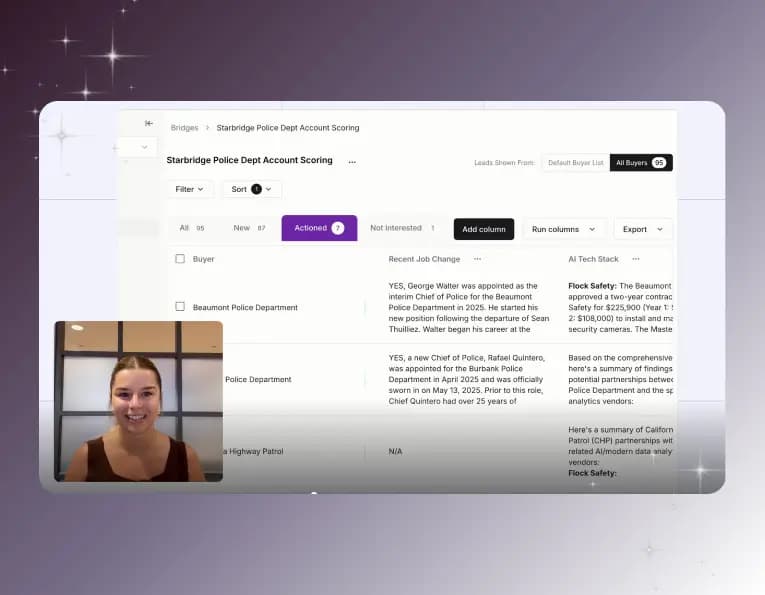 Automate account research with AI agentsStop manually researching accounts. Starbridge AI agents automate account research by monitoring buying signals 24/7 and surfacing the right contacts.
 Identify competitor contract expiration datesThe RFP is usually a formality. Starbridge surfaces competitor contract expiration dates so your reps reach accounts before the renewal cycle closes.
 Create a conference campaignTurn conference badge scans into pipeline. Import your contact list, surface buying signals across every account you met, and follow up with context.